Our World Underwater
Underwater Photography Exhibition & Silent Auction
Hosted by the North Carolina Aquarium on Roanoke Island
Silent Auction open November 15th, 2025 - February 15th, 2026 - AUCTION NOW CLOSED
All proceeds go directly to the NC Aquarium Society
Auction #1

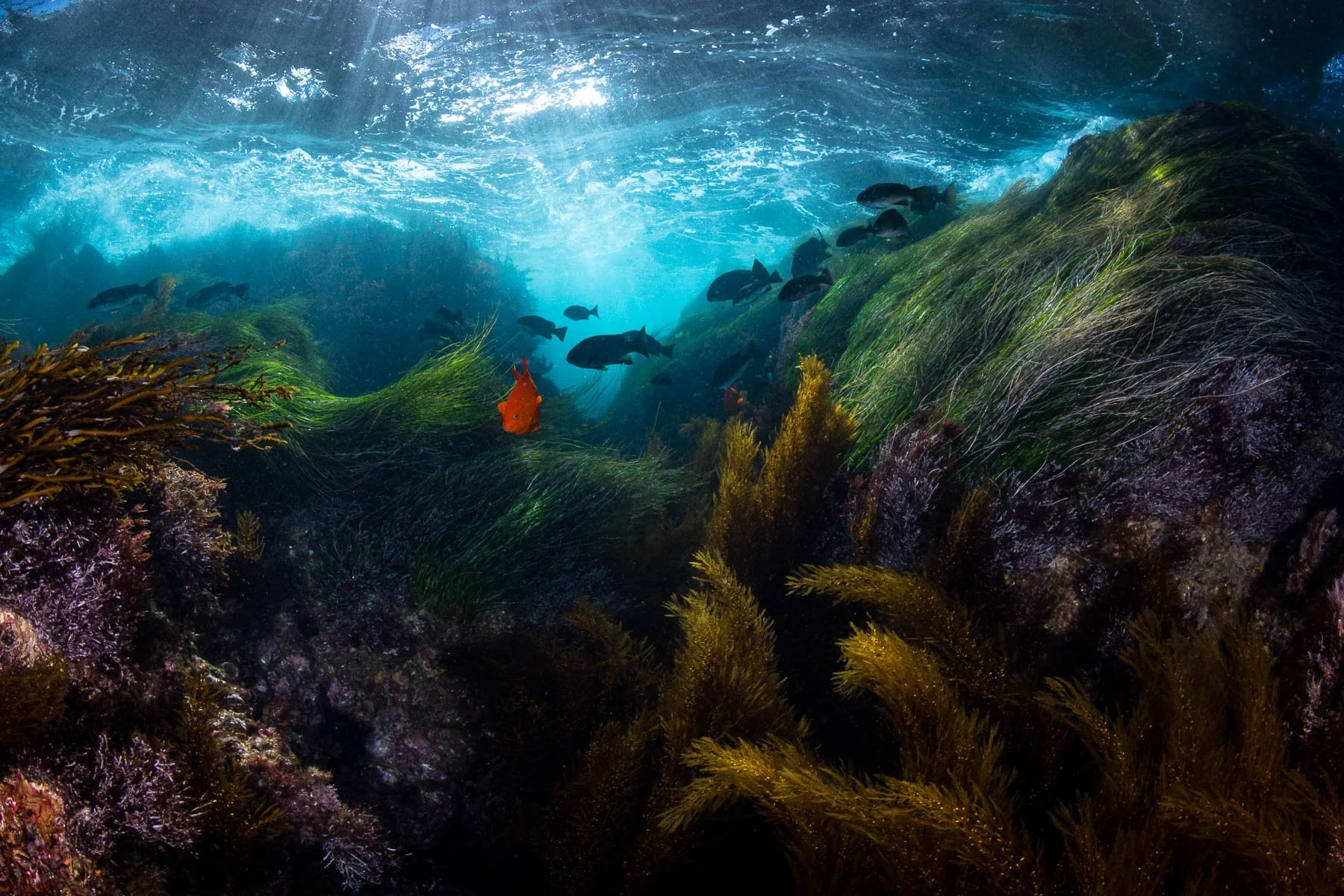
SoCal Seascape
Garibaldi (Hypsypops rubicundus) | Channel Islands National Park, CA
A bright orange Garibaldi, Hypsypops rubicundus, and a juvenile California sheephead, Semicossyphus pulcher, swim near red gorgonian, Lophogorgia chilensis, in a kelp forest off the coast of Santa Barbara Island. Located within California’s Channel Islands National Park, Santa Barbara Island is home to a surprising diversity of animal and plant life. Schools of halfmoon, topsmelts, and blacksmiths can be found meandering through the dense kelp forests found here. As these islands are a distance away from the mainland, waters tend to be clearer, lending to great photographic opportunities throughout the Channel Island chain. The entire Channel Island chain has been designated as a Marine Protected Area, which allows these kelp ecosystems many benefits, some more easily observed than others.
Auction #2
Translucent green giant kelp, Macrocystis pyrifera, grows toward the surface off the coast of San Barbara Island. During the long days of summer, giant kelp can grow up to 2 feet per day, meaning they are in a constant battle with their neighboring kelp stalks for light. The complex 3-dimensional structure of the kelp forest habitat, lends to its high biodiversity by allowing creatures with different roles within the ecosystem to all have their own space to call home. From brittle stars and urchins which inhabit the understory, to the seabass and garibaldi that swim in the midwater column, all the way up to the canopy, where harbor seals and shorebirds can be seen resting on floating kelp fronds, every piece of the kelp forest environment is utilized. This speaks to the critical importance of this place. It is also home to the critically endangered Giant Sea Bass, which were almost completely wiped out before a moratorium on their harvest was put into place in 1982.
Most people think kelp is a plant, because of its appearance, but it is actually a species of brown algae found in the Kingdom Protista. Instead of having a true root system, they have a holdfast, which acts in the same manner as a plant’s roots would. Where plants have leaves and stems, kelp has fronds and stipes, serving similar purposes, but formed through a different pathway. This process is known as convergent evolution, or the independent development of similar traits by organisms that are not closely related. So although kelp looks like a plant, it's actually algae!

Reach for the Light
Giant Kelp (Macrocystis pyrifera) | Channel Islands National Park, CA
Auction #3

Apex
Great White Shark (Carcharodon carcharias) | Guadalupe Island, MX
A white shark, Carcharodon carcharias, swims in the protected waters of Guadalupe Island, off Baja California Norte, during the annual white shark migration along Mexico's Pacific Coast. Guadalupe Island has been designated as a UNESCO Biosphere Reserve for its ecological significance to some of our ocean’s top predators. These highly migratory elasmobranchs migrate from all over the Pacific Ocean to this island for several months of the year, for feeding and mating opportunities. Their migration coincides with pupping season for resident colonies of both elephant seals and sea lions, providing ample food after their long travel. Although male and female white sharks spend most of their time segregated in the open ocean, their paths cross at this small meeting point for a short window every year.
Auction #4
A green sea turtle, Chelonia mydas, swims over the rocky reef, deep within the Matlahuayl State Marine Reserve in La Jolla, as sunbeams shine down in the background. The area known as “Turtle Town” is home to several resident green sea turtles that can be found year round with a bit of luck. Characterized by rocky outcroppings lined with seagrass and separated by patches of sand, Turtle Town hosts a variety of marine life that changes through the seasons. Green sea turtles, sevengill sharks, harbor seals, and even the critically endangered giant sea bass can be found by snorkelers and divers who have the patience to scan the seagrass for its inhabitants. Marine reserves serve an important role in providing much-needed protected habitat for these animals, they would otherwise be under constant threat of human-related dangers such as overfishing, habitat destruction, and pollution, to name a few.

Sea Turtle Sunburst
Green Sea Turtle (Chelonia mydas) | San Diego, CA
Auction #5

Delicate Drifter
Purple-striped Jelly (Chrysaora colorata) | Islas Coronados, MX
A purple-striped jelly, Chrysaora colorata, drifts past the dive site “Middle Grounds” located in the Islas Coronados island chain off Mexico’s Pacific Coast. This relatively large jelly species can be over 3 feet long from its bell to tentacle tips. Similar to other jellies, these creatures use their tentacles and oral arms to capture a wide variety of prey and then slowly migrate their catch towards the bell. Underwater lighting was utilized in this image to show the stunning purple, white and pink colors which gives the animal its name. These drifting invertebrates are carried across the ocean by prevailing currents, meaning assigning a home range can sometimes be difficult.
Auction #6
Strawberry anemones, Corynactis californica, seen attached to the structure of the Ruby E wreck off the coast of San Diego, California. These creatures attach themselves to the hard structure in colonies and feed off nutrients in the water column utilizing structures called mesenterial filaments, which are used similar to our hands, to grab particles and draw them in towards the body. The Ruby E is one of several artificially sunk wrecks originally championed by a local sportfishing association, but has since become a local favorite for scuba diving due to its proximity to port and its abundance of life.

Strawberry Surprise
Strawberry Anemone (Corynactis californica) | San Diego, CA
Auction #7

Morning Snack
Green Sea Turtle (Chelonia mydas) | San Diego, CA
A green sea turtle, Chelonia mydas, feeds on red algae in the shallows of the Matlahuayl State Marine Reserve in La Jolla, as sunbeams shine down in the background. Due to its ease of access and unique animal encounters, the dive site known as “Marine Room” is a staple for San Diego shore divers. A short swim from La Jolla Shores beach, this shallow dive can have you rubbing shoulders with creatures like horn sharks, leopard sharks, cownose rays and the “bell of the ball”, Green Sea Turtles. The seagrass covered rocks, sand channels and stands of boa kelp make a perfect habitat for sea turtles to live year-round, and it would not be complete without their favorite snack, red algae! Protected seagrass beds such as this one are vital not only to the animals that live here, but the ocean ecosystem as a whole.
Auction #8
A juvenile California sea lion, Zalophus californianus, comes in for a closer look at its reflection in the camera’s dome port. During pupping season at Islas Coronados, divers have the unique opportunity of coming face to face with sea lions, some of which are younger than one year old! These inquisitive youngsters take every opportunity to explore, learn and play when approached by the few divers who visited this off-the-beaten-path dive site. You can find them in the shallows chewing on seagrass, blowing bubbles with mouths wide open, or occasionally even posing for a picture when struck with curiosity. It’s not unheard of to have 10 or more all conducting their own operatic ballet through the seagrass until an adult male joins in the fun, only to corral them back to the safety of the rocks.
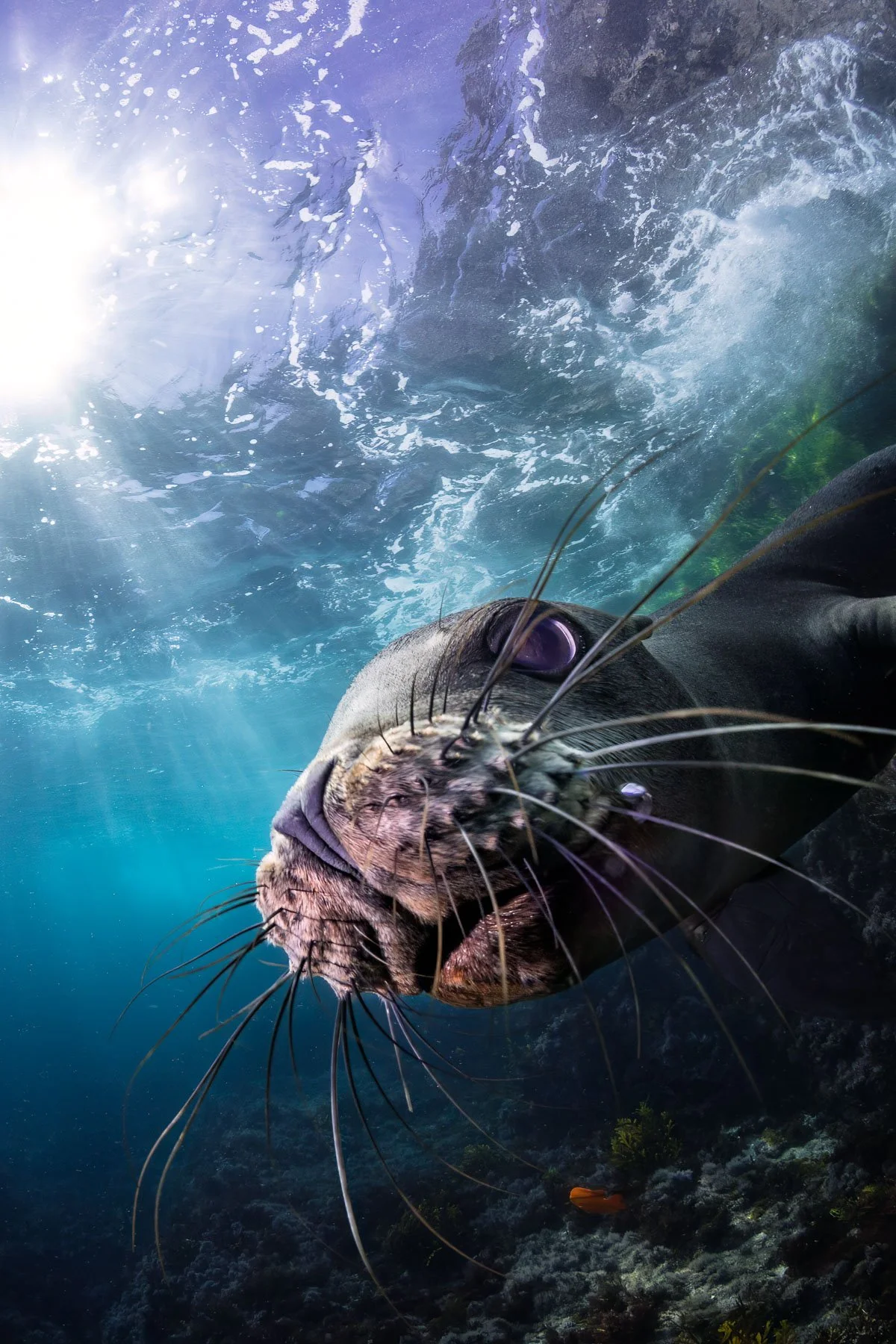
Curious Whiskers
California Sea Lion (Zalophus californianus) | Islas Coronados, MX
Silent Auction Terms & Conditions - AUCTION NOW CLOSED
Bidding is open from 9am on November 12th. 2025 to 9pm February 15th, 2026
Auction Closes at 9pm on February 15th, 2026 and the highest bid for each auction item will be considered the winning bid. Winners will be notified via email at the email address provided on the bid form.
Finality of Bids: Once a bid is made and accepted, it is considered final and binding. All sales are final, with no refunds or exchanges. All items are sold in their current condition, with no guarantees or warranties provided.
Items may be withdrawn by the auction organizer without prior notice.
Bidders assume all risks associated with the bidding process and the item itself.
Winning bidders must pay the full amount of bid within 2 weeks of receiving notification of winning bid. Cash and credit card are accepted for auction item payment.
Delivery Options & Item Collection/Pickup: All art prints can be shipped within the continental US, shipping not included in bid amount. Art prints can also be picked up locally in Manteo, NC.
Processing and Shipping Times: Once payment for winning bid items has been secured, items will be shipped within 5 business days.
Mounting Methods: All art prints come with appropriate mounting hardware.
All silent auction proceeds go directly to the NC Aquarium Society to fund ocean conservation and marine research.
Ocean Art with Purpose.
All proceeds of every art piece goes directly to funding ocean conservation and marine research.

Wildlife Art Prints